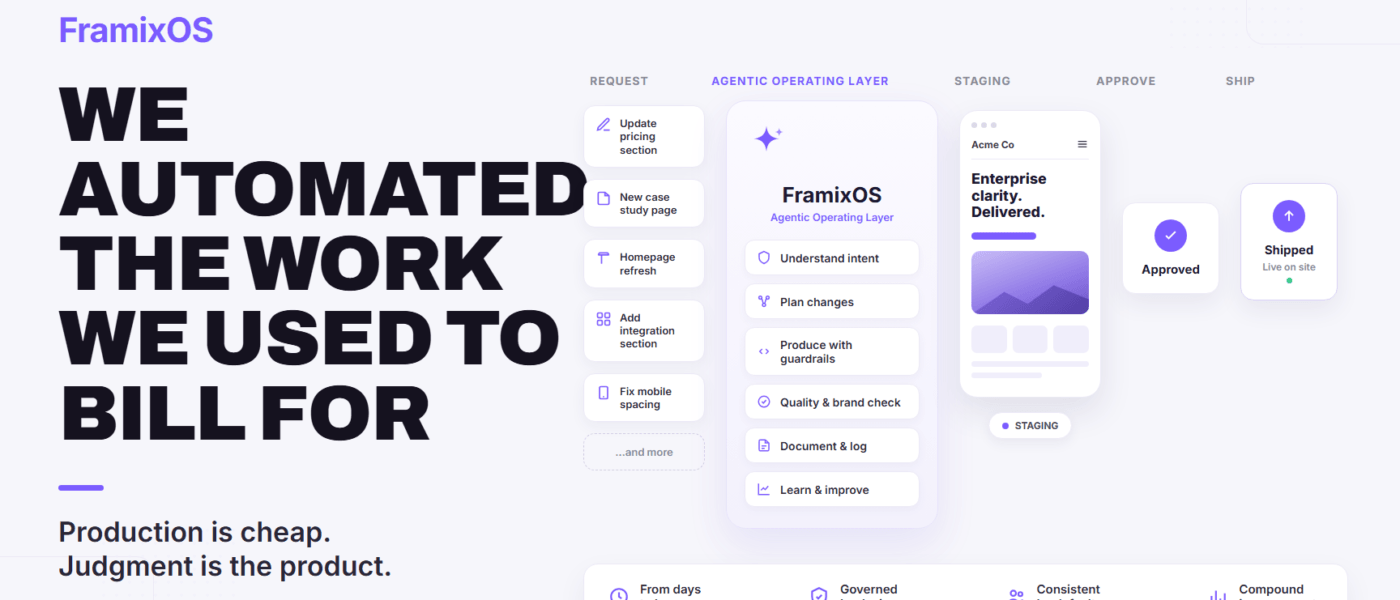
FramixOS is an agent-first operating layer that lets a marketing team run its own website in plain language: describe a change, watch it land on-brand in staging, approve it once, and it ships to production through version control. We built it, we run it on real client sites across several industries today, and this is the story of why an agency chose to automate the work it used to bill for.
Our CEO posted something this week that reads like a mistake: we built the thing that takes our own job away, on purpose. For fifteen years the model was simple. A client asks, the agency does the work, the client waits, then pays. The site edits and the landing pages were the revenue. This week we shipped a product that hands most of that straight back to the client.
Most agencies would call that giving away the business. We think it’s the only honest read of where the work is heading.
What is FramixOS?
FramixOS is an agent-first operating layer that lets a marketing team run its own website through a guarded agentic setup, built on Anthropic’s Claude Agent SDK. A marketer describes a change in plain language; the agent makes it, on-brand, in staging; one human approval ships it to production through version control. It’s already running sites for several clients, across different industries, today.
It isn’t a website builder, and it isn’t a chatbot bolted onto a CMS. It’s the layer a senior agency team would be, encoded so it moves at the marketing team’s tempo instead of the agency’s queue.
Underneath that plain-language interface sits a growing library of more than fifty built-in skills, sub-agents and tool integrations: content operations, component-aware edits, brand checks, environment-aware deployment, audits, workflow handoffs. The aim isn’t one big chatbot. It’s a governed operating layer where every capability inherits the same brand, codebase, permissions and context.
Why would an agency automate the work it gets paid for?
Because the queue was never the value, and the work inside it was already being automated by everyone.
We built it for ourselves first. We’re a small team of senior developers and a designer, friends who’ve shipped together for years, and we kept hitting the wall every agency hits: good work routes through senior people, and senior people are finite. Every small request waited on someone senior. Every project began by hunting down logins and rebuilding context someone already had. That isn’t a staffing problem you can hire your way out of. It’s how the agency model works. So we rebuilt the model. The pages, the sections, the builds that marketing used to pay an agency for are being automated whether we lead that shift or wait for it to arrive. We’d rather be the team that built the tool than the team it replaced.
How does FramixOS change a live site without breaking it?
Every change runs through one channel-blind dispatch that enforces permissions, audit and database-level tenancy, then lands in staging for a human to approve before version control deploys it.
The specifics matter, because “safe AI edits” is easy to claim and hard to mean:
- One dispatch, every channel. State-changing requests flow through a single path in
@framix/platform. The capability gate, the audit log and Postgres row-level security all live there. Today the channel is the web app; tomorrow it’s MCP, an agent-to-agent handoff, a REST call, a CLI. None of them can re-implement the rules. - Tenancy at the database. Postgres enforces row-level security on twenty workspace-scoped tables. A query that forgets to filter by workspace returns nothing, not someone else’s data.
- The agent reads before it acts. Each project has a brain: a git repository holding the brand, the design system, the codebase shape and the environments. The agent loads that context first, which is why a change lands on-brand rather than generic.
- Approval is a gate, not a suggestion. The approve action is cap-gated and audited; nothing reaches production without it. Staging deploys on a push to
staging, production on a push tomain. Every change is a version-controlled commit, so it can be reviewed, reverted and traced.
That chain is what “it can’t break the site” actually means. Not a promise. A pipeline.
What actually stays hard?
Expertise. That’s the whole bet.
Making things stopped being the hard part. What stays hard is knowing what to build: direction, brand, taste, the call on what’s worth shipping and what to cut. Production this fast only amplifies the expertise behind it. Point it at a clear, opinionated roadmap and you get more of the right thing; point it at noise and you get more noise, faster. The scarce input is the expertise, and good marketing has always run on exactly that.
FramixOS replaces the queue, not the expertise.
It’s why we’re comfortable automating production. We spent fifteen years getting good at deciding what to build, and how. Cheap production makes that expertise worth more, not less.
What changes if you run marketing?
The roadmap is yours to set and ship at your own tempo. No briefing a request and waiting a week. You describe the change, you watch it land on-brand in staging, you approve it, it goes live. Your campaign calendar stops depending on someone else’s ticket queue. The question stops being “can we get this built?” and becomes “is this worth shipping?”
The humans behind the platform, the design system, the infrastructure and the AI workflows are still us. The waiting is the part that’s gone. We’re documenting the rollout in public across our writing.
Key takeaways
- FramixOS is an agent-first operating layer that lets a marketing team run its own site in plain language, built on Claude Agent SDK, with one-approval, version-controlled shipping.
- Beneath the interface sits a library of more than fifty skills, sub-agents and tool integrations, each inheriting the same brand, codebase, permissions and context.
- The safety is structural: one channel-blind dispatch, Postgres row-level security on twenty tables, a per-project brain for context, and a cap-gated approval before deploy.
- Production is becoming cheap; expertise is the scarce input, and it’s what the system amplifies. FramixOS replaces the queue, not the expertise.
- An agency that automates the work it bills for is reading the trend honestly, not giving away the business.
FAQ
What is FramixOS?
FramixOS is an agent-first operating layer, built on Anthropic’s Claude Agent SDK, that lets a marketing team change its own website in plain language, with on-brand staging and one-approval, version-controlled deploys. Beneath the interface is a library of more than fifty skills, sub-agents and tool integrations that share one brand, codebase and permission model.
Does FramixOS replace the agency?
FramixOS replaces the queue, not the expertise. It removes the wait for routine site updates, page edits and campaign tweaks. The senior work still matters: strategy, brand direction, design systems, infrastructure and governance. The agency’s role shifts from being the production bottleneck to designing and governing the operating system that lets the client move faster.
How does FramixOS avoid breaking the live site?
Every change passes through a single dispatch that enforces permissions, audit and row-level tenancy, lands in staging, requires a human approval, and deploys as a version-controlled commit that can be reverted.
What does FramixOS run on?
Anthropic’s Claude Agent SDK with Claude Code, a Next.js and TypeScript platform, and PostgreSQL with row-level security across twenty workspace-scoped tables.